

Creating Conditions for Freedom
- Mai Ryuno
- May 8
- 4 min read

Learning Outcomes
I recently read an article, The Death of the Art School (Topkan, 2026). It described how art schools are collapsing under financial pressure and increasingly operating like businesses, where students become customers, education becomes a product, and measurable outcomes replace experimentation, risk, and collective inquiry.
What struck me most was not only the argument about art schools, but the recognition that this shift begins much earlier.
I see it in my own teaching.
I teach drawing at a community college, mostly working with students coming directly from local public high schools. At the beginning of one semester, I gave my students a survey and asked a simple question: Why are you taking this class?
Out of 24 responses, 13 students answered: “It’s required for my degree.”
The next most common answer was learning technical drawing skills. A few students mentioned art as a possible career. And then there were quieter responses:
“Learn anything about art and be able to have the courage to share my art.”
“I’ve been drawing for a while and I’m still trying to figure out myself with my own art.”
Most students arrive expecting to learn how to draw. Not how to work like an artist.
By that, I don’t mean producing gallery work. I mean learning how to stay with uncertainty, follow questions without predetermined answers, make decisions without constant approval, and develop ideas through process.
Many students who succeed within conventional systems have learned to prioritize clarity, efficiency, and correct outcomes. Open-ended inquiry can feel unfamiliar, even risky.

Conditions for Experimentation
I saw this clearly during a recent collaborative project.
Students worked in groups to research historical artworks for inspiration, create original compositions using their own photographs, and translate those compositions into large-scale collaborative drawings using a grid process. The project had clear structure, deadlines, and technical requirements. But once students had to move beyond instructions and make creative decisions of their own, the energy in the room shifted.
One group rushed toward the final drawing before fully understanding what “original composition” meant. They recreated the historical artwork too closely, simply replacing the figures with themselves. Because they had already invested so much in the early version, revising became difficult. They stopped experimenting and kept asking for approval before moving forward: Is this okay? Is this what you want?
Another group moved much more slowly. They spent most of their time discussing ideas, revising compositions, and trying to understand the intention behind the project. Their final drawing was less polished, but the process belonged to them. The decisions were theirs. So were the uncertainties.
That difference stayed with me.
Meaningful outcomes emerge from deep engagement with process. But process itself has become increasingly difficult to trust.
I don’t think this is simply a problem in art education. I think it reflects a broader shift in how learning is understood. Process is often treated as inefficient because its outcomes cannot be fully predicted in advance. Yet the most meaningful forms of learning often emerge precisely through uncertainty, revision, mistakes, and sustained inquiry.
My relationship to these systems has never been straightforward. I grew up in Japan and attended public school through high school before majoring in English at a private university. At 21, I came to the United States as an exchange student, later studied art at a community college in Monterey, and eventually attended graduate school at an art school in San Francisco.
I know what it feels like to move between different educational structures and different ways of thinking about learning. Art school opened something for me, but not because it provided answers. It created conditions for experimentation, conversation, risk, and collective imagination.
The article describes art school as a place where life opens beyond what people inherit. I recognize that experience in my own life. But increasingly, many institutions can no longer hold the conditions that made that opening possible.
Reappearing Elsewhere
So I’ve been asking myself: what happens if we create those conditions elsewhere?
That question is part of why I transformed my studio into Play Full Ground, a creative microschool and learning lab for young people in Monterey.
I think of this work as both education and art practice.
The medium is not only art making or workshops. The medium is the creation of conditions: structures that support curiosity, collaboration, experimentation, and shared inquiry. Freedom, in this context, does not mean the absence of structure, but the presence of structures spacious enough for people to think, question, and make meaning together.
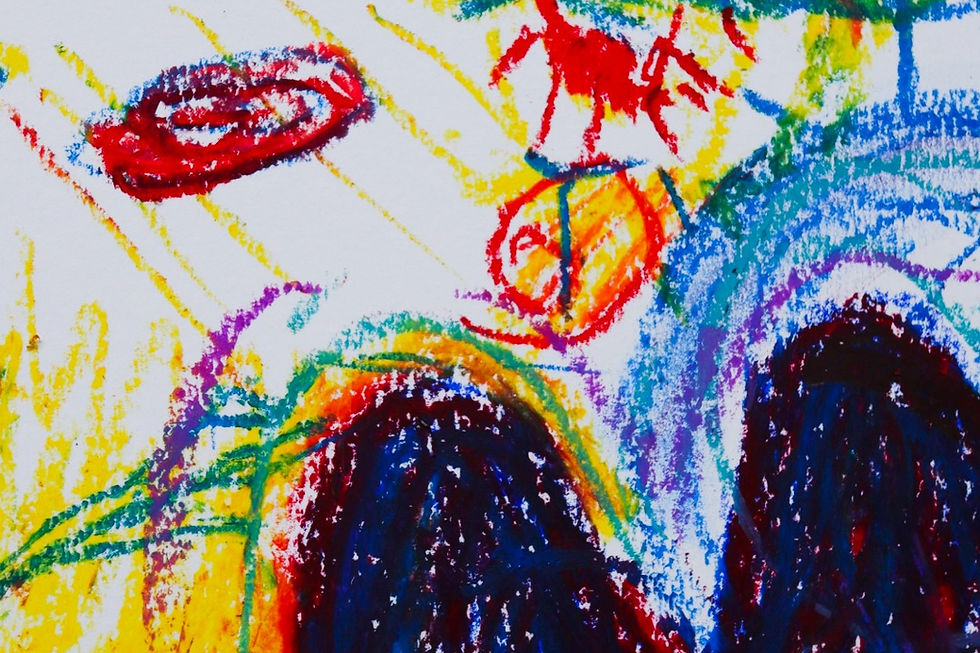
Recently, during one of our first Co-Creation Studio sessions, two students worked on collaborative drawings by switching papers every five minutes. They decided the timing and process themselves. Based on earlier conversations, I introduced small constraints: drawing on larger paper, rotating the images upside down and sideways, interrupting familiar habits. We talked about how difficult it can be to break patterns and how creativity often emerges through those disruptions.
The studio no longer functions only as my private workspace. It has become a shared site for experimentation.
This is still small. Still forming.
I’m working with only a few students right now, and there is no polished model to point to. We are figuring things out together. That uncertainty is part of the practice.
What I learned from projects like Speak Not So Easy is that the most important thing I can do as an artist and educator is not to control outcomes, but to create conditions where something unexpected can emerge collectively.
The students lead. I support. And together we build something none of us could fully design in advance.
Maybe that’s what art education was always supposed to protect: not a credential or a career path alone, but the collective capacity to imagine, question, experiment, and create new forms of life together.

What if the art school is not disappearing, but reappearing elsewhere? In studios, living rooms, community spaces, and small experiments built by people willing to learn without demanding certainty first?
Play Full Ground is one small experiment.
There should be others.


Comments