

Play Full Ground: Art as a Way of Learning
- Mai Ryuno
- Jan 19
- 3 min read

Play Full Ground prioritizes process, experimentation, and community—helping young artists build confidence through inquiry, not imitation.

Questioning the Model
Traditional art education often emphasizes mastery, correctness, and recognizable outcomes. Students are taught to replicate techniques, follow instructions, and meet expectations. While these structures can produce polished results, they often leave little room for curiosity, experimentation, or personal inquiry.
My vision for Play Full Ground grows from questioning this model. What happens when art education prioritizes process over product, and thinking over compliance?
Play Full Ground is an artist-led microschool where art is treated not as a set of skills to be perfected, but as a way of learning, reflecting, and engaging with the world. Students participate in project-based courses across 2D, 3D, lens-based practices, and creative technology. These courses are intentionally open-ended, designed to invite exploration rather than guide students toward a single outcome.
A common practice in traditional art education is asking students to copy a master’s artwork. While this method has historical precedent, many artists and educators question what it actually teaches. Copying can train the hand, but it rarely trains decision-making. The student’s role becomes one of accuracy rather than inquiry. The voice being practiced is someone else’s.
At Play Full Ground, influence is welcomed, but imitation is not the goal. Students study artists and movements as points of entry rather than templates. Instead of asking whether something looks correct, the questions shift toward noticing, interpreting, and responding. Art becomes an active dialogue rather than a test of fidelity.
“It took me four years to paint like Raphael, but a lifetime to paint like a child.” — Pablo Picasso
When “Good at Art” Isn’t Enough
I have seen the consequences of outcome-driven art education appear later in students’ lives. In my community college art classes, many students arrived having been labeled “good at art” throughout high school. They were technically capable and often externally successful. Yet when asked to create their own work, they struggled.
What emerged was not a lack of skill, but difficulty in beginning. Without clear instructions or models to follow, students felt uncertain and dissatisfied. Years of working toward predefined answers had taught them how to meet expectations, but not how to generate ideas from themselves. Being good at art had not necessarily helped them feel like artists.
Conversation Before Instruction

This experience shaped my way of teaching. Rather than directing students through predetermined steps, I support them in developing and realizing their own ideas through the creative process. Students share their ideas, and we discuss how those ideas might take form. The conversation focuses on exploring possibilities, testing directions, and identifying next steps rather than judging what is “good.”
These discussions become the foundation for experimentation. Once ideas have been explored out loud, students move into making with a clearer sense of direction, but without a fixed endpoint. They test materials, try unexpected approaches, and revise based on what the work reveals. Failure and iteration are treated as essential parts of the process, because each revision opens new possibilities and deepens understanding.
Experimentation, Failure, Iteration
A concrete example of this process can be found in the Speak Not So Easy program. Students began with a shared theme of self and community and were supported in developing their ideas into form. Through conversation, the group chose video as a medium and hosted a screening and discussion that invited audience attention, curiosity, and shared reflection.
Later, the students collaborated on a public installation: a transparent umbrella-like gazebo made of sheer fabric. Members of the public were invited to step inside, select a prompt, and respond by writing or drawing on colorful fabric pieces cut into irregular shapes. Over time, these pieces were pinned onto the structure, becoming part of the artwork itself. The project moved from personal reflection to public dialogue, emphasizing creative practice over a “correct” outcome.
Speak Not So Easy: From Self to Community
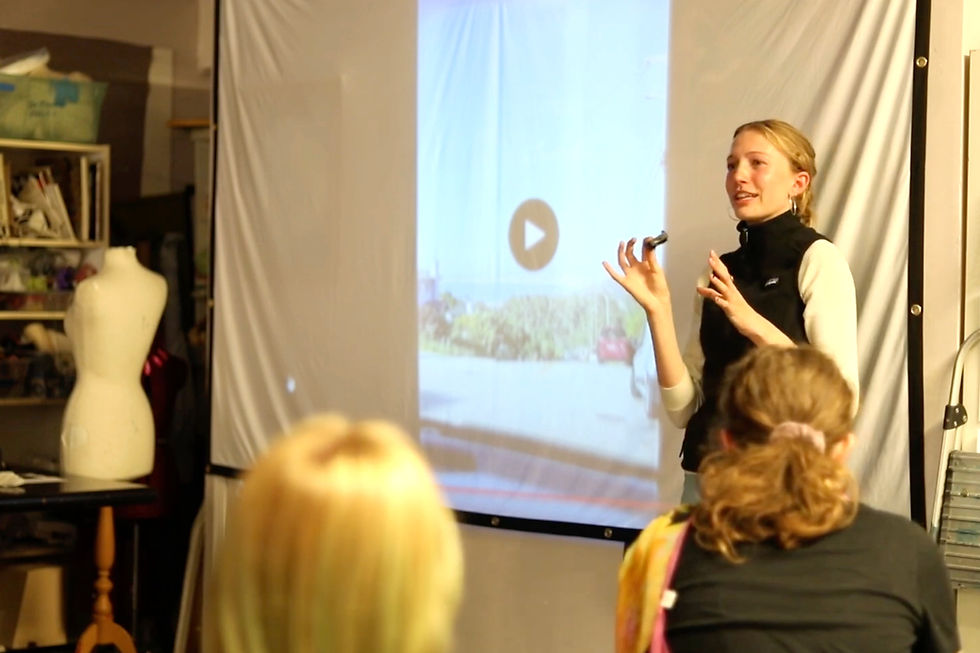
Play Full Ground is also about community. Students learn alongside peers, sharing questions, observations, and discoveries. Collaboration is not supplemental; it is central. Through this collective environment, students begin to see art as more than making objects. Art becomes a way of thinking, questioning, and imagining.

Art as Radical Pedagogy
At its core, this microschool treats art itself as a form of radical pedagogy. Creation becomes a method of learning. Multiple “right answers” are not only allowed; they are expected. Young people are given permission to experiment, take risks, and turn ideas into forms that feel meaningful to them.
Ultimately, my vision is to cultivate a generation of thinkers, makers, and collaborators who carry creativity, reflection, and community engagement into all areas of life. Art is not the destination. It is the ground from which everything else can grow.


Comments