

Do You Paint?

What Counts as a Canvas?

When people learn that I am an artist, one of the first questions I often hear is:
“Do you paint?”
It is a simple question, but I have come to think there is a much bigger question hidden inside it:
What do we recognize as art?
I understand why people ask. Painting is one of the most familiar images of what an artist does. A canvas, a surface, colors, marks, and an image that can be displayed and viewed. It is a language many people already know.
My answer is yes, sometimes.
But I have started thinking about this question differently.
What if painting is not only a medium, but a way of seeing?
Beyond the Single Image
Installation view - printmaking work
I did not begin my artistic practice as a painter. I studied printmaking.
I appreciated the patience and process required by the medium, but I was never particularly interested in producing editions in the traditional sense. I was more interested in exploring what the process could make possible.
Even within printmaking, I found myself looking beyond the individual image.
How do images relate to each other?
How does an artwork change when it enters a space?
How does repetition create difference?
Looking back, I can see a pattern.
I have always been drawn to possibility.
A blank surface.
A material.
A space.
A question.
What could happen here?
The Studio as Canvas

When I first moved into my studio, the space felt like a blank canvas.
The walls were empty, and the room held many possibilities.
Over time, I added furniture, tools, artwork, and materials. But the transformation of the studio did not happen only through objects.
It happened through people.

The space was not only shaped by things.
It was shaped by experiences.
Workshops filled the room with conversation and making. Visitors stopped by and shared ideas. Collaborations formed. Students gathered, experimented, and imagined together.
The studio became activated through the stories, relationships, and memories created inside it.
I have come to realize that my artistic practice is not only about making objects.
I am interested in creating the conditions for stories to happen.
The objects I make matter, but often they are not the final destination. They are part of creating an environment where something else can emerge.
A white tablecloth and dress from my earlier work invited people to leave their marks and stains.
The white surface was intentional.
It was not simply empty.
It was an invitation.
A space waiting for something to happen.

Happy Monterey Sardine, Pacific Grove Museum of Natural History installation
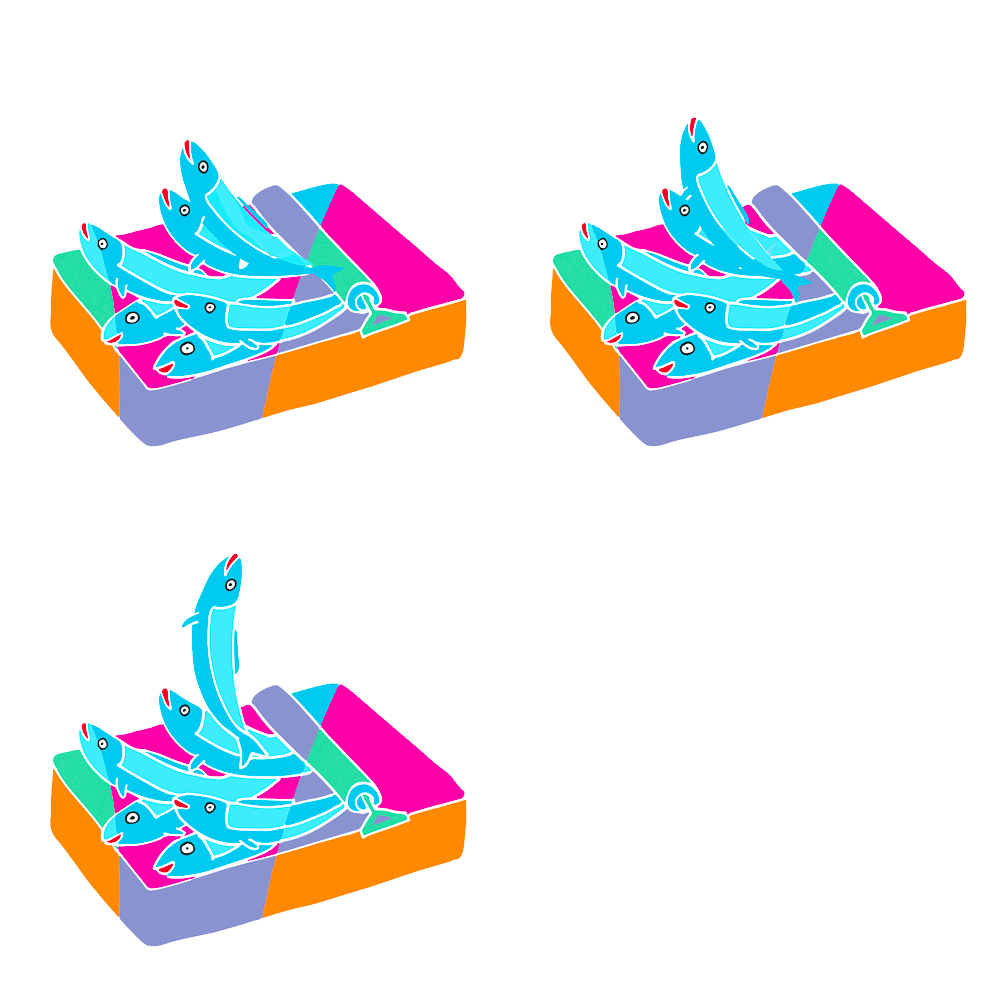
My soft sculptures inspired by Monterey Bay creatures, including Happy Monterey Sardine, are another example.
Visitors naturally connected with the handmade creatures as the artwork. They were certainly part of it.
But what interested me most was the world they helped create: a playful underwater environment inside a natural history museum where people could gather, interact, and imagine.
The objects created a place for something to happen.
Over time, I have become more interested in forms of art that are not only meant to be looked at, but experienced.
Artists have always worked with many kinds of materials. Some use paint, clay, photography, or sound. Others work with conversations, participation, gatherings, relationships, and shared experiences.
These materials may not always be immediately visible.
But they are not insignificant.
Trust is invisible.
Belonging is invisible.
Memory is invisible.
Curiosity is invisible.
One role of artists is making invisible things visible.
Sometimes this happens through an object we can see and touch.
Sometimes it happens through creating a moment that would not have existed otherwise.
A gathering.
A conversation.
A collaboration.
A shared memory.
A Place for More Yeses
Wave painting workshop, created with participants and the ocean
This way of thinking continues to shape my practice today.
The wave painting project is one example.
The final fabric is part of the artwork, but the artwork also includes the ocean, the participants, the unexpected movement of the waves, and the memories created through the process.
A gathering.
A conversation.
A collaboration.
A shared memory.
I think of the studio as a place for more “yeses.”
Not a place where every idea becomes a finished artwork, but a place where curiosity is welcomed long enough for something unexpected to emerge.
The Dream List began from this idea: a collection of possibilities waiting to be explored.
Some ideas may remain dreams for a while.
Others may become experiments, collaborations, or unexpected paths.
Cold Topics is one example of a dream becoming action: taking an idea from the list and creating a space to explore it.
A dream can become a list.
A list can become an experiment.
An experiment can become a story.
This is the kind of possibility I hope to create through my practice: spaces where people can imagine, try, connect, and discover what might happen.
So when someone asks me, “Do you paint?”
My answer is still yes.
But I have come to think of painting more broadly.
Painting begins with a surface and an imagined possibility. Through choices, responses, and relationships, something emerges that did not exist before.
Sometimes that surface is paper or fabric.
Sometimes it is a room.
Sometimes it is a gathering.
Sometimes it is a community.
The question is not only whether I paint.
The question is:
What counts as a canvas?


Comments